
Dersu Uzala
After the summer Ancient Savo sales have been slowly diminishing, so that for the autumn it has not made any meaningful income for me. That is how it often goes, with indie developments. I have a whole bunch of ideas I still want to implement in the game, and it remains to be seen if any of the future improvements will affect the sales. But at this stage of the development the money doesn't matter that much, I will anyway work on updating the project, just because I find those planned features interesting coding challenges, so the joy of coding is a value in itself. Yet, to avoid going back to the strain of "chronically earning less than the monthly bills", I've been open to any odd jobs to earn instant income. And it has been lucky with that, for at the milling company they have needed a whole bunch of updates, which means extra work for me. The downside is slower progress with Ancient Savo - and the infrequent blog updates. The following story took place already a month ago, but only today I feel like taking the time to sit down and write a blog post.
As most of the Finnish countryside, the local villages have been on slow decline. A bit simplified, it looks like a self-fueling spiral of "population going down because of less babies born, students and young adults moving to cities, businesses quitting because of not enough customers, less job opportunities because of businesses quitting, more people moving away due to lack of local jobs" and so on. But of course that is not the full story. For example they started a brand new film festival at the village. New things happening! I'd guess that it isn't quite anything creating paid jobs, but still it is something which brings more interesting content for the local population to enjoy - and if they continue to do it, maybe it can grow to something to bring more guests visiting the village. I was vaguely thinking that the film festival might be something I'd like to volunteer myself - maybe, some year, if my income and schedules ever get a bit more stable and settled =)
This year I had time to see only one film at the festival, at Friday evening. It was Dersu Uzala, directed by Akira Kurosawa, on a physical 16mm reel. There was about a dozen people watching. Before the film there was a short speech by a curator who had chosen the film as a part of "Forest" theme. The curator was a professor in ecological sciences, reflecting on some themes to be seen in the film, mentioning some of his personal memories and experiences, and also comparing some aspects of Dersu Uzala to the other hand-picked films of the "Forest" theme. That made me realize all the benefits of going to a film festival - in addition to the film itself you get food for thought (and no commercials before the film itself).
Well, I try not to spoil the movie for I highly recommend watching it if possible! If I understand correctly, the movie is based on a book, which in turn is based on real-life experience of the author. Which also makes me want to read the book. The film is set in early years of 1900, and there is a Russian expedition charting a sparsely populated territory in the taiga of far east Siberia. They accidentally meet a local indigenous hunter, a self-sustained vagabond hunter whose name is Dersu Uzala. They make friends with Dersu, and he joins the expedition as a local guide. His skills and knowledge soon prove invaluable.
Of course, the film in itself could easily make several blog posts, if I'd go into details commenting about all the thoughts and feelings it sparked in my mind. But for now I will just mention three themes, more or less briefly;
Dersu has an animistic view of the world - for him all the animals, wind, water and fire are personalities, with their emotions and intentions. For him some animals are sacred and should not be harmed, and generally speaking Dersu seems to see the human - environment relationship as one of co-operation. Often when leaving a campsite he leaves some food and other resources there, just so that if a hungry human or an animal happens to be in need they will be relieved by what they find. He often evaluates people to be "good" or "bad" based on if they show traits of mutual respect, or if they are plainly greedy and selfish. The captain of the expedition has a more materialistic and scientific view, but he grows to respect Dersu's wisdom. This made me think of a more general theme - I think it is easy to see how many of the indigenous belief systems helped to regulate human behavior so that they didn't overuse local resources but maintained a healthy respect towards Mother Nature. But if those beliefs appear as superstitious and untrue to the scientific mind, does it mean that the rational mind is not constrained by the moral rules of the superstition? Once people no more believe in supernatural entities judging them as "bad people", they can just go on selfishly taking all they need? In the era of 21st century ecological catastrophe looming, does the humanity need to go back to the supernatural beliefs to avoid disturbing the balance of the global and local ecosystems? I don't think so - for even when thinking in purely rational and materialistic manner it should be clear that we humans, as a species, depend on the biosphere, and that if critical natural systems fail (or, even if they just go dramatically turbulent) it means serious trouble for all of us. So, if the global human activity threatens the balance of biosphere, it is not just "bad behavior" in a supernatural belief system, for it is also counterproductive and self-destructive behavior if evaluated with cold hard rationality. What I try to say is that I don't see rationality or scientific thinking as problems in itself; it is more like the contemporary human culture seems to be in a some kind of transitional period - we are no more fully restricted by age old supernatural animism, but we haven't yet fully adopted rational and critical thinking. It is this short-sighted only-partly-rational thinking which brews trouble. I don't know but I have a feeling that the more scientific and rational thinking develops, the more it aligns with many of the core insights of ancient animistic and shamanistic beliefs; we just find a new way of understanding how we depend on powers beyond our control. Back to the film; just like in classic Western movies, the modernity is brought by the railroad, and the old-fashioned self-sustained lifestyle has to withdraw or to get overridden. I wonder if that modernism of the railroads is going to get replaced by yet further steps of cultural developments...
My second comment is more closely connected to the movie itself. There is a scene where Dersu and The Captain of the expedition accidentally find themselves in a situation where they are likely to freeze to death. The only resource available is dry stalks of grass, but luckily there is an abundance of them. Dersu instructs the captain to harvest the dry grass, and that is what they do. And they cut, collect, carry, stack, cut, collect, carry, stack, cut, collect, carry and stack the hay. I have no idea how many minutes Kurosawa shows that repetitive work - certainly a lot longer than one would expect to see in a Hollywood movie. But Kurosawa clearly wanted to deliver the sense of this being hard work taking a long time. So the audience feels almost like being there; the light grows dimmer, the captain grows fatigued, the cold harsh wind blows and whispers like Death itself. I really liked the daring decision to spend a lot of time for this scene. Later on I was visiting Sami, and told about the film festival. Sami said that he remembers seeing the film on TV in his childhood or early teenage years - and all that he can remember is Dersu's face, and that there was a dim winter night scene of cutting dry grass. So, clearly, the scene left a lasting impression on Sami's mind as well. (I do wonder if that somehow subconsciously has affected UnReal World development, for I think some aspects of the game have a similar kind of atmosphere. That sometimes survival is a question of managing to collect enough dry branches to start a fire, before your hands get all frost-bitten.)
I hope this won't spoil too much of the movie, but towards the end there is the contrast between urban living in a city, and the solitude freedom of a hunter in the wilderness. Yes, Dersu needs to stay with the Captain's family in their city residence. Sure, food and warmth are more secured there, but Dersu quickly feels himself like a duck in a cage, having nothing to do but to stare at the fire in the fireplace. Living in the countryside myself, my first thought was that many of the problems would've been solved if they were in a rural village instead of an early 20th century Russian city. For even today the life in the countryside still allows many of the activities Dersu was longing for - you are free to chop down trees to make your firewood, you can carry water, and if you want to you can live in a tent on the yard. But maybe the Captain and his family didn't have a datcha in the countryside, nor any rural relatives who could've hosted Dersu. So, let us just assume that life in the countryside was not an option. It still leaves a lot of room to wonder why and how the urban life is. When on the expedition in the wilderness we often see captain and his men singing together, sitting together by the fire telling and listening to stories - we see none of that in the urban setting. I can understand why people can't just go on chopping down trees in the city; but surely the city doesn't prevent people from gathering to sing together? Or, maybe that is something which only happens in a tavern, where you pay to consume alcohol? Somehow the urban scenes left me with a feeling that in the cities we have a lot of people densely packed in a small area, but somehow those people are more separated, disconnected and alone compared to the social life we saw in the wilderness. (This also reminds me of some scenes in Tarkovsky's Solaris.) Oh well - I have a feeling that on some very deep level this is connected to the theme of "the transition period of human culture" - most of us have already left behind the old-fashioned hunter-gatherer life-style, but maybe the replacement is still heavily under development? Maybe the urban life is still under-developed, waiting to find new shapes and forms, something which would better favor and encourage people having both emotional and rational connection to nature, to themselves, to their fellow beings? I wonder what will be the next railroad, bringing along the new way of life ...
---
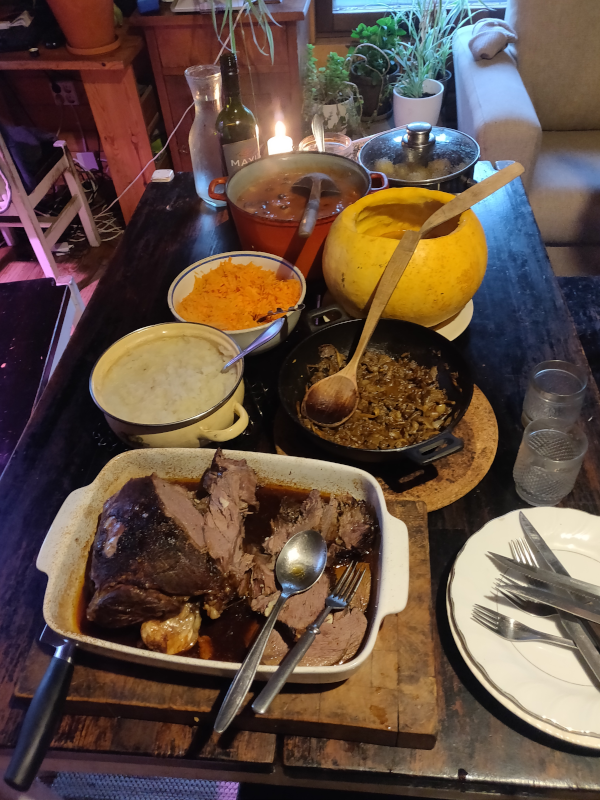
Oh, so - where was I? Yes, it was that particular Friday evening in mid-October. After seeing Dersu Uzala I drove back home and started to cook a variety of foods, with most of the ingredients either home-grown or gathered from the nearby woods. I have been living here for 17 years, and in that time I have seen many of the neighboring houses having their inhabitants die, move away or live in a elders' care home. And some of the nearby houses have got new inhabitants, people in their 30's who do arts and crafts and prefer to live in the countryside. That brings a nice balance to my otherwise semi-hermit way of life, for meeting friends doesn't always mean traveling for an hour or four. I can just walk a forest trail to meet friends. And occasionally we gather at someone's house to eat together, telling stories and laughing, and occasionally also singing together. For me this is pretty close to the ideal way of life, a good combination of solitude and social life, traditional and modern elements. But I also feel that I don't want to write that much about the social life with the neighbors, for I haven't asked their explicit permission; for myself I can choose how much of my personal life I'll expose to the wide open internet, but I certainly don't want anyone to feel that visiting my house means appearing in a blog story. (This has a lot to do with the way my own mind works - when I have social life with the neighbors, it feels more honest just to be fully present in the moment, not "documenting life as it happens". Maybe on some occasion I could especially ask if some of the neighbors feel comfortable with a blog visit.)
The harvest season meal, about the be enjoyed together with neighbours.
Blog entries

Follow us
Elk News - the email newsletter
Subscribe to the Elk RSS feed, including blog posts, pictures and videos.
Titles only
Full content
Comments aren't included in these feeds. For them you can click the RSS icon in the Recent Comments box.
Our videos at
YouTube
Comments
I've been transplanted from a city life to a more-rural-life for a few years now. I'd say that a rural life is more rich, but it comes with a cost. This cost can be either your work and/or time, or paying for something or someone to do the work for you. Richness comes from doing things yourself, but you have to be eager to learn. I've learnt countless things (and paid for many of them, too), some of them I was not so eager to learn, but I preferred to do them myself anyway. I've also received much help from many people for which I'm grateful.
This year I've moved back to some city for a quick stint. I felt cozier for a while, as I only had to cook and do some chores from time to time. I had many hours to read/think. But I had to do something to not atrophy physically, so I did many hours of walking. I think I understand why some philosophers liked to walk, as it is one of not so many free things that you can do in a big city. I notice that not many people like to walk just for the sake of walking, most of the time they are forced to do it or choose cars. I wonder whether that's one of the reasons that they feel depressed.
I'd be very wary to recommend someone to just move to the countryside. It comes with a certain cost. But when I was reading this post, I couldn't stop thinking of a word that comes with a big baggage nowadays. This word is "sustainability". I feel that life in a city is, in most cases and in cases recommended by current culture, not sustainable. It will either deplete your mental of physical state if you're not careful. I'm not saying that countryside is sustainable per se, but for me it offers more nice things to recharge myself. When I'm having a bad day, half an hour of wood chopping or just pottering around the garage does wonders. But I also had to learn this. It's not always easy, as there are indeed some things that I miss from my city-dwelling days.
I don't know where I'm going with this comment. I wouldn't like to hijack any of your thoughts. But this was a really interesting read and I hope to give another perspective on those things.
I will watch the movie for sure, as "Dreams" from AK was a eye-opening watch!
Thanks for the additional perspective, this is good!
Also, in the movie the captain and his family appear to be comfortable with the city life, and they are hopeful that eventually Dersu will adapt and feel at home. So I must say that the "problems of living in a city" are mainly experienced by Dersu, who feels deprived of many of the aspects of his earlier free-roaming life in the vast wilderness of taiga.
But surely things are different for people who grew up in a more urban environment. On their expedition in the wilderness the captain and his men had a lot to learn from Dersu - and I'd guess if any of them would've decided to try to settle down to live in the taiga, they would've faced a lot of issues =) So, indeed - I think it is wise to avoid over-simplified statements like "everyone should move to the countryside for the rural life is better and more cozy than the urban life!". It isn't that simple, and it doesn't work like that. This is a big theme, and I try to write a blog post or two about it, this winter. But for now, just one more thing;
I'd guess one aspect is that we human beings tend to miss things we are familiar with. And sometimes we take a lot of things for granted, only noticing their value when we are away from those things. So, in the context of rural / urban life, a person living in a city might have romantic illusions of how they would enjoy the quiet simple slow-paced life in the countryside - but only when they move there, in the darkness of late November they realize how it feels not to have access to all the things which in the city simply were there with no extra effort. I think this is perfectly normal and human - adapting to new situations takes a lot of energy, and learning new things often comes with a cost.
Also, I think you are on spot with your mention of walking. That sent me thinking about Dersu's urban anxiety in a more nuanced way.
As, my first naive simple thought was just that "if they lived in a smaller village Dersu could feel more at home". Dersu's own idea to cope with the city life is to live in a tent on the yard, but he is told that people can't do that in the city. OK, fine - but could there be other ways to cope? Going out for long walks, maybe? Making contact with the other crew members of the expedition, like once a week gathering the bunch, walking out from the city somewhere where they can sit down by a fire and sing together. And walk back home for the night, or the next morning or so. Or maybe Dersu could've adopted some kind of peddler life-style; obtaining supplies from the city, then going for a week-long journeys to his native lands to distribute those supplies to the indigenous folks. So, actually, now I think that there would've been a lot of options available, but failing to see them Dersu felt trapped.
And there might be something specific to walking. In the taiga scenes it is clear that they spent most of their days walking a lot. Somehow I was mostly thinking of the social aspect - people being together around a fire, singing and telling stories. But it is very likely that the walking in itself is essential - no matter if Dersu is roaming alone, or with the expedition.
Another layer is that Dersu's hermit hunter-gatherer life-style is partially his way to cope with a tragedy, loss and trauma of his earlier life. And, already in the wilderness we see first signs of his mental well-being becoming somewhat unstable.
All these combined, and I start to feel that Dersu developed a classical depression. It was not just about feeling alien in the urban environment, but also the lack of long walks and all the other things which earlier helped Dersu to keep his mind in balance. Who knows, maybe deep down he also sensed that death is coming, which made him to miss his native lands even more?
So - yeah - things tend to be multilayered, with a complex interplay of internal and external factors either balancing each other, or triggering positive or negative feedback loops.
I'm yet to see the movie, so it's hard to talk about Dersu's case, hehe. But I just want to say briefly that I think that we are more part of the environment than we usually think we are. Eastern folks realize this better than we do (cf. Art of War as a lazy example). It's not easy to switch environmental habits in our minds in an instant, especially if we are forced to do so. So I guess that Dersu could indeed be depressed in this sense that there were no familiar anchors to rely upon in his environment, and also many of "urban customs" often seem plain stupid to rural folks, often for good reasons!
OTOH, I remember one document about a painter in which he states that he is a 100% potted plant in the sense that he belongs to the city. He didn't miss his rural roots. I also remember my grandfather who moved to a city for work reasons and he said that living and working in a city is a step-up comparing to his past life.
As you say - this is a complex and multilayered thing. I guess Kurosawa was intelligent enough to see all those shades of grey in his movies and perhaps that's why he is considered a legend, and many rural youtubers who try to push some kind of "romantic illusion" are not :)
This has been the most interesting thing I have read anywhere in a long time! Very curious about this topic and would love to hear more about the rural-urban living choice comparison etc. Love the movie and highly recommend the book too
A striking detail in Dersu Uzalas animism is that he calls every being a human. Not only a person, but a human. For example, tiger is a human for him. Great movie!
Ah, I thought that to be a case of Dersu not being a native Russian speaker, and trying to express his thoughts with a somewhat limited vocabulary. If I remember correctly, he uses the word человек , which translates as "a human", but also "a person", and "a dude" (heppu in Finnish) or "bro" (veikko). Hmm, I don't know if that really changes anything, for all in all it sounds like Dersu doesn't see a human being in any way being superior or detached from the rest of nature, but sees the other beings as equal worth, fellows with their own desires and emotions.
--- SPOILER ALERT ---
What I've been wondering - and I hope to read the book one day, maybe it sheds more light into these details;
In the very early stage, when Dersu's character gets introduced, we see him bothered or maybe even annoyed because of the campfire making constant cracking noises. Dersu takes a stick away from the fire and extinguishes it by giving it a beating, addressing the stick: "Now, will you make more noises?" - this, at the same time, displays the depth of Dersu's animism, but also raises some questions about when to treat everything with respect, and when it is okay to impose ones own will on other living beings. (Later on Dersu says that it gets very bad when wind and fire are angry. I take this to mean that in Dersu's world semi-brutally extinguishing a burning stick doesn't run the risk of angering the spirits of fire)
On a similar note, Dersu seems to be perfectly fine with hunting animals for food, and also hunting animals for furs to get extra money. But Dersu condemns unnecessary killing of animals of prey, saying that people should disarm their traps when they don't need them anymore. Still, it feels like the Tiger has a special status - or, I wonder if there is anything like a subtle hierarchy hidden in Dersu's worldview, that there are "lesser" beings and "higher" beings. But Dersu also mentions there being a more general God-like Spirit of the Forest, so maybe it is that The Tiger holds a special meaning or connection with the main Spirit of the Forest, so harming a tiger means angering the Forest Spirit?
(Finally, a bit of sidetracking: Dersu appears to have strong conflicting feelings when he asks for bullets, so that he can go hunting for fur animals. When seeing the movie I interpreted that as him feeling "greedy, bad person" who is "asking too much" - but now as I write this comment, I wonder if Dersu is more bothered with his own plan to go killing animals not for food but for (luxury) extra money. Hmm...)
All in all - great movie, yes!
Pages
Add new comment